AI Agents vs AI Workflows: Why Most Businesses Are Asking the Wrong Question

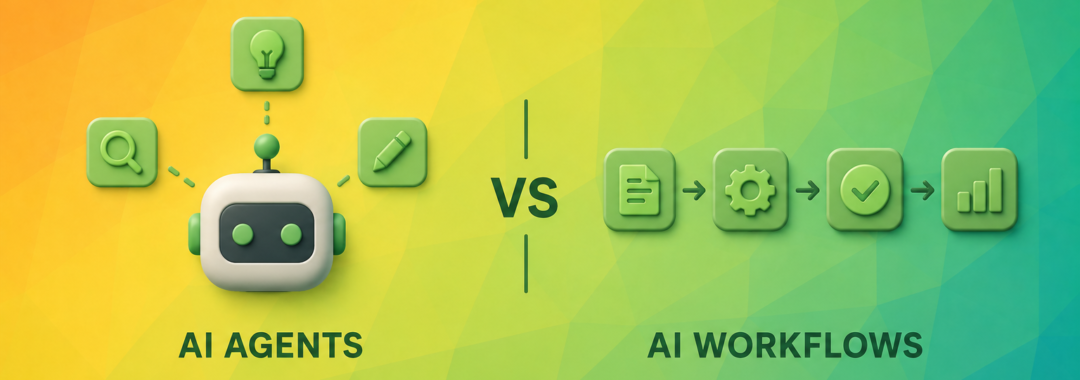
Short answer: AI workflows improve individual steps inside a business process you already control. AI agents reason about the problem and act autonomously. Both use large language models, but most enterprises get more value – faster, more reliably, and at lower risk – from AI workflows, not autonomous agents.

If you’ve attended an AI conference, opened LinkedIn, or spoken with a software vendor over the past year, you’ve probably noticed the same pattern: everyone suddenly wants AI agents.

Not document automation. Not workflow optimization. Not better business processes. Agents. Somewhere along the way, autonomous AI agents became the default answer to almost every business problem. Companies that only recently started experimenting with ChatGPT are now asking how they can build fully autonomous systems capable of making decisions, coordinating tools, and replacing manual work.

It’s easy to understand why. The latest demonstrations from OpenAI, Anthropic, and Google are genuinely impressive – AI can browse the web, write code, analyze documents, plan tasks, and interact with software in ways that seemed impossible just a few years ago. Naturally, business leaders look at these demonstrations and ask a reasonable question: “Can we build something like this for our company?”

Sometimes the answer is yes. More often, though, the answer is something else entirely. After working on AI-powered enterprise software, logistics platforms, and operational systems, we’ve learned that most organizations don’t actually need autonomous AI agents. They need better workflows. That may sound less exciting – but it also happens to be where most business value is created.

The Wrong Question Most Companies Start With

One of the biggest mistakes companies make when adopting AI is assuming that intelligence is the missing piece. It usually isn’t.

Imagine a logistics company processing hundreds of transport requests every day. Operators receive emails from customers, review shipment details, calculate profitability, assign vehicles, notify drivers, and update accounting systems. None of these activities are particularly intelligent on their own – most follow clear business rules. Yet they’re still slow. Not because employees make poor decisions, but because the workflow itself is fragmented.

Information arrives in different formats. Data is entered multiple times. Systems don’t communicate reliably. Approvals happen over email. Critical information lives in spreadsheets. Adding an AI agent to this environment doesn’t magically solve the problem – it simply automates the chaos.

This is something we also discussed in Why Enterprise Integrations Become a Bottleneck (And How to Avoid It). As software ecosystems grow, the challenge rarely becomes the individual systems themselves – it’s the complexity of the connections between them. AI depends on those same connections. If your integrations are unreliable, your AI will inherit the same problems. AI doesn’t replace architecture; it amplifies it.

Businesses Don’t Need More Intelligence – They Need More Consistency

This is perhaps the least discussed truth in enterprise AI. When executives say they want AI, what they’re often describing is something entirely different. They want fewer repetitive tasks, employees spending less time copying data between systems, customer requests processed faster, planners making decisions with better information, and fewer operational mistakes.

Notice what isn’t on that list. Nobody says, “We need software that independently invents new strategies.” Businesses don’t operate like research laboratories – they operate through repeatable processes. Every invoice follows a process. Every shipment follows a process. Every insurance claim follows a process. Every support request follows a process.

The goal isn’t to replace those processes with autonomous reasoning. It’s to make them faster, more accurate, and easier to manage. That’s a workflow problem, not an agent problem.

Why the Hype Around AI Agents Is Easy to Understand

To be fair, AI agents represent an exciting evolution of modern software. Large language models no longer just answer questions – they can plan, choose tools, execute tasks, reflect on previous outputs, and adapt to new information. From a technical perspective, that’s remarkable.

The problem begins when these capabilities are marketed as universal solutions. History has seen this pattern before: cloud computing was going to replace every data center, microservices were supposed to replace monoliths, and blockchain was expected to transform every industry. Today, AI agents occupy a similar position. They’re real and valuable – but they’re also being applied to problems they weren’t designed to solve.

Enterprise software has always rewarded predictability over novelty. Businesses care about reliability, compliance, auditability, governance, and repeatability. These priorities don’t disappear simply because AI becomes more capable. If anything, they become even more important.

Before AI Can Make Decisions, Your Business Needs To

One of the most common assumptions about AI is that it can compensate for unclear business processes. In reality, the opposite is true: the better defined a workflow is, the more effective AI becomes.

Consider an approval process inside a manufacturing company. A purchase request may require validation against budget limits, supplier agreements, inventory levels, and department approvals before it can proceed. Those aren’t AI problems – they’re business rules. AI might summarize supporting documents, extract information from contracts, recommend preferred suppliers, or flag unusual requests. But the workflow itself already exists.

Trying to replace that structure with a fully autonomous AI agent would introduce unnecessary complexity. Instead of making the process simpler, it creates new questions. Who is responsible if the AI approves the wrong purchase? How do you audit its decisions? Can finance explain why a request was accepted? How do you test future updates? These questions don’t disappear because AI is involved – they become harder.

That’s why successful enterprise AI projects rarely start with autonomous decision-making. They start by understanding how work actually flows through the organization.

Intelligence Without Structure Creates More Complexity

There’s an old software engineering principle that still applies today: automation improves good processes and exposes bad ones. AI works exactly the same way.

If employees manually move information between five disconnected systems, AI might reduce the manual effort – but it doesn’t solve the architectural problem. If customer information exists in three different databases, AI won’t magically establish a single source of truth. If planning decisions depend on outdated spreadsheets, AI won’t eliminate inconsistent data. The technology just becomes another layer sitting on top of existing operational complexity.

This is why organizations that invest in architecture often achieve better AI outcomes than those investing only in larger language models. The model matters. The workflow matters more.

Good AI Starts With Understanding Work

One pattern appears repeatedly across successful enterprise AI implementations. The projects that generate measurable business value don’t begin by asking “Where can we use AI?” They begin with a different question: “Where does work slow down?”

That’s an important distinction, because slowing work isn’t usually caused by a lack of intelligence. It’s caused by waiting, searching, copying, reviewing, reconciling, switching between systems, and repeating the same actions hundreds of times every week. Those are workflow bottlenecks – and workflow bottlenecks are precisely where AI delivers its greatest value. Not by replacing people, and not by acting autonomously, but by removing friction from how work already happens.

AI Workflows vs AI Agents: The Architecture Behind Enterprise AI

By now we’ve established that most companies aren’t really looking for AI agents. They’re looking for faster operations, fewer repetitive tasks, and better decisions. The important question is no longer whether AI should become part of the business – it’s how.

That’s where many AI initiatives begin to diverge. Some organizations build AI into existing workflows. Others attempt to build autonomous agents capable of making decisions on behalf of the business. Both approaches use large language models, and both can produce impressive demonstrations. But only one is usually the right architectural choice. The difference isn’t the model – it’s the role AI plays inside the system.

AI Workflows Are Designed Around Business Processes

The easiest way to understand an AI workflow is to stop thinking about AI altogether and think about the business process instead. Every organization already runs on workflows: a customer submits an order, a shipment is created, an invoice is approved, a support ticket is assigned, an insurance claim is reviewed.

The workflow already exists. People know what happens first, what information is required, and which decisions need approval versus which can be automated. AI simply improves individual steps – it might classify incoming emails, extract structured information from documents, summarize contracts, recommend the next action, or generate reports. But the workflow itself remains predictable.

That’s exactly why workflow-based AI scales so well inside enterprise environments. The AI isn’t responsible for the business; the business remains responsible for the business. AI simply removes friction.

AI Agents Change the Architecture

AI agents operate differently. Instead of completing predefined tasks, they’re expected to reason about the problem itself. An agent may decide which systems to query, which tools to call, whether more information is needed, which task should happen next, and whether the objective has been completed.

This flexibility is what makes AI agents exciting – and it’s also what makes them considerably harder to design. Every additional degree of autonomy introduces new architectural questions: Who validates the output? Who owns the decision? How are failures detected? How do you audit the reasoning process? How do you reproduce a decision six months later? These aren’t prompt engineering questions. They’re software architecture questions – and software architecture has always been the hardest part of enterprise software.

Architecture Matters More Than the Model

One of the biggest misconceptions in enterprise AI is that choosing the right model is the most important decision. Should we use GPT-4? Claude? Gemini? Open-source models? In reality, these decisions often have less impact than the surrounding architecture.

We’ve discussed a similar principle in our article on RAG vs Fine-Tuning for Enterprise AI Assistants. Many organizations immediately assume they need to fine-tune a model when the real challenge is connecting the model to reliable company knowledge, structured business data, and existing systems. Exactly the same principle applies here: whether you’re building AI workflows or AI agents, the architecture surrounding the model usually determines long-term success. The model is only one component. The workflow is the product.

A Real Enterprise Workflow

One of the clearest examples comes from logistics. In our Logvision project, AI processes incoming transport requests arriving from multiple sources. At first glance, someone might describe this as an AI agent. It isn’t.

The process begins when transport offers arrive by email. AI extracts relevant shipment information, and the extracted data is validated against business rules. Planning algorithms calculate profitability, dispatchers review recommendations, operational systems update planning data, accounting receives structured information, and reporting reflects the completed operation.

Notice what’s happening. AI performs several important tasks, but it never becomes responsible for the entire operation. Business logic still belongs to the platform. Operational decisions still belong to the organization. The AI simply accelerates a workflow that was already understood – which is one reason the platform can scale without sacrificing predictability.

If you’re interested in how these architectural decisions translate into production systems, our Logvision case study explores the design challenges behind building an AI-powered logistics platform.

Good AI Doesn’t Replace Enterprise Software – It Extends It

There’s another misconception that’s becoming increasingly common: that AI will eventually replace ERP systems, CRMs, or warehouse management platforms. In practice, we’re seeing the opposite.

The most successful AI projects don’t replace enterprise software – they extend it. An ERP already contains years of business logic. A CRM already defines customer relationships. A warehouse platform already understands inventory. Replacing these systems with autonomous AI would mean rebuilding decades of operational knowledge.

Instead, AI becomes another capability inside an existing software ecosystem. It summarizes information, finds patterns, speeds up repetitive work, and supports decision-making – but the enterprise platform remains the source of truth. This is one of the reasons our Custom Software Development approach focuses on evolving existing business systems rather than replacing them wholesale. AI creates the most value when it strengthens software architecture – not when it attempts to become the architecture.

Autonomy Creates New Engineering Problems

Giving AI more responsibility doesn’t simply increase capability – it also increases risk. Imagine an autonomous purchasing agent that receives supplier requests, negotiates pricing, approves purchases, schedules deliveries, and updates accounting. On paper, this sounds impressive. In production, dozens of new engineering problems appear almost immediately.

What happens if supplier pricing changes unexpectedly? What if regulations require human approval? How are financial decisions audited? Who becomes responsible when the AI chooses the wrong supplier? How do you investigate a mistake weeks later? These challenges have very little to do with language models. They’re questions of governance, compliance, and system design. That’s why enterprise AI isn’t fundamentally an AI problem – it’s an enterprise architecture problem.

The same architectural thinking is essential when designing integrations between ERP systems, CRMs, AI services, and operational platforms. As we explored in Why Enterprise Integrations Become a Bottleneck (And How to Avoid It), complexity doesn’t grow because organizations adopt more technology – it grows because the relationships between systems become harder to manage. AI becomes one more participant in that ecosystem, not a replacement for it.

Most Businesses Already Know the Right Answer

Interestingly, many organizations unknowingly choose AI workflows before they ever consider AI agents – because they’re solving practical problems. A support team wants AI to summarize tickets. Finance wants invoices extracted automatically. Operations wants shipment emails converted into structured planning data. HR wants resumes categorized. Legal wants contracts summarized.

None of these objectives require autonomous reasoning. They require consistency, predictability, integration, and reliable business rules – and those characteristics describe AI workflows remarkably well.

Choosing the Wrong Architecture Is Expensive

One of the hidden costs of AI hype is that companies sometimes build for tomorrow’s problems instead of today’s. They invest months designing autonomous agents while employees still copy information manually between systems, still wait for approvals, and still switch between six different applications to complete one task.

That’s not an AI problem – it’s a workflow problem. Before increasing AI autonomy, organizations should reduce operational friction, because removing ten manual steps usually creates more business value than building one autonomous agent.

Choosing the Right AI Strategy for Your Business

Enterprise AI is entering a new phase. A year ago, the biggest question was whether businesses should use AI at all. Today, the question is completely different: what kind of AI should we build? A chatbot? An AI assistant? An AI workflow? A fully autonomous agent?

The answer isn’t found by comparing models or reading benchmark scores. It’s found by understanding how your business operates. The companies generating the highest return on AI investment aren’t necessarily building the most advanced AI systems – they’re building the right ones.

The AI Maturity Pyramid

One of the biggest mistakes organizations make is trying to skip directly to autonomous AI agents. In reality, successful AI adoption usually follows a much more predictable path. We’ve found it useful to think of enterprise AI as a maturity model rather than a collection of technologies.

Level 1: Foundation

Before automation or AI, the basics have to be in place – reliable systems, clean data, and processes people actually agree on. Without this foundation, everything built on top inherits the same weaknesses.

Level 2: Process Automation

The next step isn’t AI – it’s automation. APIs replace spreadsheets, systems exchange information automatically, notifications become event-driven, and business rules become consistent. Organizations that skip this step often discover that AI spends more time compensating for broken processes than creating value.

This is also where scalable software architecture becomes critical. A well-designed platform is far easier to automate than one held together by manual workarounds and disconnected systems. If you’re modernizing legacy applications, our Custom Software Development Services focus on creating software that’s ready for automation – not just AI.

Level 3: AI Workflows

Now AI begins enhancing specific parts of the business. Documents become structured automatically, customer emails are classified, knowledge is retrieved intelligently, planning recommendations are generated, and reports are summarized.

Notice what hasn’t changed: business ownership. The workflow still belongs to the organization – AI simply performs specific cognitive tasks inside it. This is where the majority of enterprise AI projects deliver measurable business value today.

Level 4: AI Decision Support

The next step isn’t autonomy – it’s collaboration. AI begins making recommendations rather than executing actions independently. Examples include:

  • Pricing suggestions
  • Demand forecasting
  • Logistics optimization
  • Anomaly detection
  • Fraud identification
  • Predictive maintenance

Humans remain responsible for the final decision, but those decisions become faster and better informed. This pattern is increasingly common across enterprise software because it balances efficiency with accountability.

Level 5: AI Agents

Only after workflows, automation, and governance are mature does autonomous AI begin to make sense. At this stage, agents may:

  • Coordinate multiple tools
  • Plan long-running tasks
  • Collaborate with other AI systems
  • Execute predefined objectives
  • Recover from failures independently

Even then, successful enterprise agents rarely operate without boundaries. Permissions remain controlled, actions are logged, and critical decisions still require oversight. Autonomy isn’t the objective – reliable outcomes are.

Why Most Companies Try to Start at Level Five

The answer is surprisingly simple: autonomous AI agents make for excellent demonstrations. Watching an AI browse websites, call APIs, and complete complex tasks feels revolutionary. Building enterprise software is rarely revolutionary – it’s iterative.

Businesses don’t become more competitive because they adopted the newest technology. They become more competitive because they consistently execute better processes than their competitors. That’s why mature organizations tend to ask a different question. Instead of asking “Can AI do this?” they ask “Should AI be responsible for this?” Those are very different conversations.

Five Questions Every CTO Should Ask Before Building an AI Agent

Before introducing autonomy into any business process, it’s worth stepping back – not to slow innovation, but to make sure you’re solving the right problem.

  1. Is the workflow already well understood? If different departments describe the process differently, AI won’t fix the inconsistency. It will amplify it.
  2. Would automation solve the problem without AI? Not every repetitive task requires a language model. Sometimes an API integration delivers the same business outcome with lower cost, greater reliability, and simpler maintenance. Choosing AI where traditional automation is sufficient usually increases complexity without increasing value.
  3. Who owns the decision? Every business decision already has an owner. Sales owns pricing, finance owns payments, operations owns scheduling, compliance owns regulations. Introducing AI doesn’t remove ownership – it makes ownership more important.
  4. What happens when the AI is wrong? No AI system is perfect, and designing for failure is part of designing for production. Can the decision be reversed? Will someone notice the mistake? Is there an approval step? Can the reasoning be audited?
  5. Can the AI access reliable information? Even the best model cannot compensate for fragmented business data – disconnected CRMs, outdated ERP records, duplicate customer information, missing documentation, poor integrations. As we explained in RAG vs Fine-Tuning for Enterprise AI Assistants, organizations often focus on improving the model when they should first improve access to trustworthy knowledge. Better context almost always outperforms a larger model with incomplete information.

The Biggest Mistakes We See

After working on enterprise software and AI-driven operational systems, several patterns appear repeatedly. Organizations automate broken processes instead of improving them. They build AI before defining business ownership. They underestimate integration complexity. They believe autonomy automatically creates efficiency. And they evaluate AI success based on demonstrations instead of operational metrics.

None of these problems are caused by language models – they’re caused by implementation strategy. This is one reason why enterprise AI projects increasingly resemble software engineering projects rather than standalone AI initiatives. Success depends just as much on architecture, integrations, governance, and product thinking as it does on machine learning.

It’s also why AI should never be treated as an isolated feature. Like any other enterprise capability, it becomes harder to evolve when it’s bolted onto software instead of designed into the architecture from the beginning 0 a challenge we explored in How Enterprise Software Becomes Unmaintainable (And How to Prevent It).

AI Is Becoming Part of Software Engineering

Over the next decade, we expect AI to become a standard capability within enterprise platforms rather than a separate product category. CRM systems will include AI. Warehouse platforms will include AI. Planning systems will include AI. Healthcare software will include AI. Financial platforms will include AI. The distinction between “AI software” and “software” will gradually disappear.

The engineering challenge won’t be choosing a model – it will be designing systems where AI works predictably alongside existing business logic. That’s why organizations investing in modern software architecture today are also preparing themselves for tomorrow’s AI capabilities. Whether you’re introducing workflow automation, intelligent decision support, or autonomous agents, your software foundation determines how quickly those capabilities can evolve.

This philosophy shapes how we approach both our AI Development Services and Custom Software Development Services. AI isn’t a standalone product that sits beside your platform – it’s a capability that should strengthen the software your business already depends on.

Final Thoughts

The debate between AI agents and AI workflows often misses the bigger picture. The real question isn’t which technology is more advanced – it’s which one creates measurable business value. For most organizations, that journey begins with better workflows. Not because AI agents lack potential, but because businesses rarely struggle with a lack of intelligence. They struggle with inconsistent processes, disconnected systems, and unnecessary operational friction.

Solve those problems first, and AI becomes dramatically more effective. Eventually, many organizations will adopt AI agents, and some already should. But the companies that achieve lasting success won’t be the ones that deploy autonomous AI first. They’ll be the ones that understand their business well enough to know exactly where autonomy creates value – and where it doesn’t.

Frequently Asked Questions

What is the difference between an AI workflow and an AI agent?

An AI workflow uses AI to improve specific steps inside a business process that the organization still owns and controls – classifying emails, extracting data, summarizing documents. An AI agent reasons about the task itself and decides autonomously which tools to use and what to do next. Workflows prioritize predictability; agents prioritize flexibility.

Do most businesses need AI agents?

Usually not – at least not first. Most enterprise problems are caused by inconsistent processes and disconnected systems, not by a lack of intelligence. AI workflows and decision support deliver measurable value with lower risk, while autonomous agents make sense only after automation, workflows, and governance are mature.

Does AI replace ERP or CRM systems?

No. The most successful projects extend enterprise software rather than replace it. ERPs, CRMs, and warehouse platforms already encode decades of business logic. AI adds capabilities on top – summarizing, finding patterns, supporting decisions – while the platform remains the source of truth.

What should a CTO check before building an AI agent?

Whether the workflow is well understood, whether plain automation would solve the problem without AI, who owns the decision, what happens when the AI is wrong, and whether the AI can access reliable data. If any answer is shaky, fix that before adding autonomy.


Best AI Architecture Patterns for Logistics Systems

Introduction

Modern logistics systems are no longer only transportation platforms.

They are increasingly becoming real-time operational intelligence systems.

From our experience building enterprise logistics software and AI-enabled operational platforms, the biggest challenge in logistics is rarely transportation itself.

The real challenge is operational coordination across:

  • routes
  • vehicles
  • warehouses
  • financial systems
  • communication channels
  • planning workflows
  • and constantly changing operational data

This complexity creates an environment where traditional software systems struggle to scale efficiently without automation and intelligent orchestration.

As a result, AI is becoming increasingly important in logistics infrastructure.

But many logistics AI projects fail because companies focus on isolated AI features instead of system architecture.

AI in logistics is not only about:

  • chatbots
  • prediction models
  • or automation scripts

It is about designing operational systems where:

  • data flows correctly
  • decisions remain explainable
  • workflows stay scalable
  • and AI integrates into real operational processes

Understanding which AI architecture patterns work best in logistics systems is critical for building platforms that remain operationally sustainable at scale.

Related:

RAG vs Fine-Tuning for Enterprise AI Assistants

How to Scale a Mobile App (From MVP to Thousands of Users)

Why Scaling a Startup Too Early Usually Backfires


Who This Guide Is For

This guide is written for:

  • CTOs
  • logistics software companies
  • product teams
  • enterprise engineering leaders
  • technical founders

building AI-enabled logistics platforms or operational systems.

It is especially relevant if:

  • you are integrating AI into logistics workflows
  • you are scaling operational systems
  • you need real-time planning infrastructure
  • you are automating logistics operations

This guide is particularly useful for:

  • fleet management systems
  • warehouse systems
  • transportation platforms
  • supply chain software
  • route optimization systems

If you are trying to answer:

“How should AI be integrated into logistics systems?”
“What AI architecture patterns scale operationally?”

this guide provides a practical architectural framework.


Why Logistics AI Is Different From Consumer AI

Most consumer AI systems optimize for interaction.

Logistics AI systems optimize for operational decisions.

This changes everything about the architecture.

In logistics environments:

  • data changes continuously
  • workflows depend on timing
  • operational costs matter heavily
  • decisions affect real-world operations

Unlike consumer AI systems, logistics AI must operate inside:

  • routing systems
  • planning pipelines
  • operational workflows
  • geolocation systems
  • financial processes

This means AI becomes part of infrastructure rather than a standalone interface.

The strongest logistics AI systems therefore focus on:

  • orchestration
  • automation
  • operational visibility
  • structured decision support

instead of only conversational interfaces.


The Most Important Logistics AI Architecture Principle

The most effective logistics AI systems separate:

  • operational data
  • orchestration logic
  • AI reasoning
  • workflow execution

This separation is critical.

Because logistics environments evolve continuously:

  • routes change
  • pricing changes
  • delivery conditions change
  • operational constraints change

If AI systems become tightly coupled to operational workflows, maintenance complexity grows rapidly.

Scalable logistics AI architectures therefore prioritize:

  • modularity
  • workflow orchestration
  • operational flexibility
  • explainability

Related:

How to Build a Startup Product Roadmap (Without Turning It Into a Wish List)


The Most Effective AI Architecture Patterns for Logistics Systems

1. Retrieval-Augmented Operational Systems (RAG)

One of the strongest logistics AI patterns combines:

  • retrieval systems
  • operational databases
  • AI reasoning layers

This allows systems to:

  • access current operational data
  • retrieve route information
  • analyze delivery constraints
  • support real-time decisions

instead of relying on static model memory.

This becomes especially important in logistics because operational data changes continuously.

Related:

RAG vs Fine-Tuning for Enterprise AI Assistants


2. AI-Powered Workflow Orchestration

In logistics systems, AI often functions as a workflow coordinator.

Instead of generating standalone responses, AI helps orchestrate:

  • planning processes
  • operational prioritization
  • scheduling logic
  • route assignment
  • delivery workflows

This creates:
👉 AI-enabled operations
instead of:
👉 isolated AI tools

Workflow orchestration becomes significantly more important than pure model capability.


3. Structured Data Normalization Pipelines

One of the biggest logistics problems is fragmented operational data.

Information arrives through:

  • emails
  • PDFs
  • APIs
  • spreadsheets
  • ERP systems
  • third-party integrations

AI-powered normalization pipelines help:

  • extract operational information
  • structure unformatted data
  • standardize workflows

This dramatically improves automation capabilities.


Real Enterprise Example: AI Logistics Planning Infrastructure

In enterprise logistics platforms like Logvision, AI is deeply integrated into operational planning systems.

Related Use Case:

URL: https://logicnord.com/use-cases/logistics-software-development-case-study-logvision-fleet-route-management-platform

The platform processes incoming transport offers from unstructured email sources, extracts logistics information using AI-powered parsing pipelines and converts operational data into structured workflows. 

The system combines:

  • AI-powered email parsing
  • structured data normalization
  • route optimization
  • profitability analysis
  • GPS integrations
  • operational planning workflows

to support real-time logistics decision-making. 

A key component of the architecture is an AI-powered planning system that evaluates transport offers and identifies profitable logistics decisions dynamically. 

This type of infrastructure demonstrates how logistics AI increasingly depends on:

  • orchestration systems
  • retrieval pipelines
  • operational integrations
  • structured workflow engines

instead of standalone AI interfaces.


4. Decision-Support AI Systems

In logistics environments, AI often performs best as:
👉 decision-support infrastructure
rather than:
👉 fully autonomous execution systems

Examples include:

  • profitability scoring
  • route evaluation
  • operational prioritization
  • load optimization

This allows:

  • human oversight
  • operational explainability
  • controllable automation

which is critical in enterprise environments.


5. Geolocation-Aware AI Systems

Location intelligence becomes central in logistics AI.

Effective architectures integrate:

  • GPS systems
  • mapping services
  • route optimization engines
  • operational constraints

This allows AI systems to evaluate:

  • delivery efficiency
  • vehicle utilization
  • operational profitability

in real time.


6. Event-Driven Operational Architectures

Modern logistics systems increasingly depend on event-driven infrastructure.

AI systems react to:

  • delivery updates
  • operational changes
  • vehicle movement
  • pricing changes
  • workflow events

instead of operating only through manual requests.

This significantly improves:

  • scalability
  • responsiveness
  • operational visibility

Where Logistics AI Systems Usually Fail

Many logistics AI projects fail for architectural reasons rather than model quality.


AI Is Treated as an Isolated Feature

Some systems add AI only as:

  • a chatbot
  • an assistant layer
  • a reporting feature

without integrating it into operational workflows.

This limits business impact significantly.


Weak Data Infrastructure

AI systems depend heavily on:

  • structured operational data
  • reliable integrations
  • clean workflows

Without strong data pipelines, AI quality degrades quickly.


Overengineering Before Operational Validation

Some companies introduce:

  • excessive AI complexity
  • advanced model pipelines
  • expensive infrastructure

before validating operational value.

This increases maintenance cost without improving workflows.

Related:

How to Add AI Features to a Startup Product (Without Overengineering)


Poor Explainability

Enterprise logistics systems require:

  • operational visibility
  • auditability
  • decision traceability

Black-box systems often become difficult to trust operationally.


Hybrid AI Architectures Are Becoming the Standard

The strongest logistics AI systems increasingly combine:

  • retrieval systems
  • orchestration layers
  • operational databases
  • workflow automation
  • reasoning engines

This creates:
👉 operational AI ecosystems
instead of:
👉 isolated AI features

Hybrid architectures scale better because:

  • workflows remain modular
  • operational systems stay explainable
  • infrastructure evolves more flexibly

This is where enterprise logistics AI architecture is moving.


Scalability and Infrastructure Considerations

Logistics AI systems operate under heavy operational pressure.

This means architecture must support:

  • real-time processing
  • high availability
  • integration scalability
  • operational resilience

As systems scale, the biggest challenges usually become:

  • orchestration complexity
  • integration reliability
  • operational latency
  • infrastructure maintainability

This is why architecture quality matters significantly more than isolated model benchmarks.

Related:

Why Most Startup Products Never Become Real Businesses

Startup Metrics That Actually Matter (And the Ones That Don’t)


A Practical Framework for Choosing Logistics AI Architecture

Before implementing AI into logistics systems, evaluate three questions.


1. Does the AI improve operational workflows directly?

If not, the system may only increase complexity.


2. Can operational data be structured and retrieved reliably?

If not, AI quality will remain inconsistent.


3. Does the architecture support explainability and scalability?

If not, operational trust and long-term maintainability become difficult.


This framework helps align AI systems with operational business value instead of technical hype.


Related Articles

Related:

The Complete Guide to Building a Startup Product (From Idea to MVP to Scale)

How to Choose a Mobile App Development Partner for a Startup

Mobile App Maintenance Cost: What Startups Ignore

How to Scale a Mobile App (From MVP to Thousands of Users)


Related Use Cases

Enterprise logistics AI implementation:

URL: https://logicnord.com/use-cases/logistics-software-development-case-study-logvision-fleet-route-management-platform

Enterprise operational platform example:

URL: https://logicnord.com/use-cases/enterprise-crm-wms-platform-case-study-dekkproff-tire-industry-management-system


Where This Connects to Product Engineering

Enterprise logistics AI systems require alignment between:

  • operational workflows
  • infrastructure
  • integrations
  • data pipelines
  • scalability planning

Product engineering helps ensure that:

  • AI systems remain maintainable
  • workflows stay operationally reliable
  • architectures scale sustainably over time

Relevant capabilities include:

URL: https://logicnord.com/services
URL: https://logicnord.com/about
URL: https://logicnord.com/technologies


Final Thoughts

The future of logistics AI is not isolated automation.

It is operational orchestration.

From our experience building enterprise logistics systems, the strongest AI architectures are not the ones using the most advanced models.

They are the ones that:

  • integrate AI into real operational workflows
  • structure operational data effectively
  • support explainable decision-making
  • and scale infrastructure carefully over time

In logistics environments, architecture quality determines whether AI becomes operationally valuable – or operationally expensive.


Author

Written by Logicnord Engineering Team
AI & Product Engineering Company

RAG vs Fine-Tuning for Enterprise AI Assistants

Introduction

Enterprise AI assistants are evolving far beyond simple chat interfaces.

Today, AI systems are increasingly integrated into:

  • operational workflows
  • logistics platforms
  • enterprise automation systems
  • internal business tools
  • decision-support infrastructure

But despite rapid adoption, many enterprise AI projects struggle long before model quality becomes the actual problem.

From our experience building enterprise software systems and AI-enabled operational platforms, the biggest challenges usually emerge at the architecture layer:

  • how knowledge is retrieved
  • how workflows are orchestrated
  • how operational data is processed
  • how hallucinations are controlled
  • how systems remain maintainable at scale

One of the most important decisions in enterprise AI architecture is choosing between:

  • Retrieval-Augmented Generation (RAG)
  • fine-tuning large language models

These approaches are often treated as direct alternatives.

In practice, they optimize completely different parts of enterprise AI systems.

This distinction matters because enterprise environments operate under constraints consumer AI applications often ignore:

  • changing operational data
  • compliance requirements
  • infrastructure scalability
  • operational reliability
  • integration complexity
  • explainability

An architecture that performs well in demos can become operationally unstable very quickly once integrated into real business systems.

Understanding when to use RAG, when to use fine-tuning and when hybrid architectures become necessary is one of the most important decisions in enterprise AI engineering.

Related:
How to Add AI Features to a Startup Product (Without Overengineering)

How to Scale a Mobile App (From MVP to Thousands of Users)

Why Scaling a Startup Too Early Usually Backfires


Who This Guide Is For

This guide is written for:

  • CTOs
  • technical founders
  • product teams
  • enterprise software companies
  • engineering leaders

building AI assistants or AI-enabled operational systems.

It is especially relevant if:

  • you are designing enterprise AI architecture
  • you are integrating AI into operational workflows
  • you need scalable AI infrastructure
  • you are evaluating long-term maintainability trade-offs

This guide is particularly useful for:

  • enterprise SaaS products
  • logistics platforms
  • internal knowledge systems
  • AI workflow automation
  • operational AI assistants

If you are trying to answer:

“Should we use RAG or fine-tuning?”
“How do enterprise AI systems scale operationally?”

this guide provides a practical architectural framework.


What RAG Actually Is

Retrieval-Augmented Generation (RAG) combines language models with external retrieval systems.

Instead of relying entirely on static model training data, the system:

  1. retrieves relevant information from external sources
  2. injects that information into the model context
  3. generates responses using retrieved operational knowledge

This allows AI systems to work with:

  • real-time enterprise data
  • internal documentation
  • operational workflows
  • external APIs
  • continuously changing information

without retraining the model itself.

In enterprise systems, RAG is commonly used for:

  • internal AI assistants
  • operational support systems
  • compliance workflows
  • enterprise search systems
  • AI-enhanced dashboards

The core advantage of RAG is not intelligence.

It is adaptability.


What Fine-Tuning Actually Is

Fine-tuning modifies the behavior of a model by training it on specialized datasets.

Instead of retrieving information dynamically, the model itself learns:

  • domain-specific patterns
  • workflow structures
  • output consistency
  • behavioral logic

This improves:

  • formatting consistency
  • response predictability
  • repetitive workflow reliability
  • domain specialization

Fine-tuning is strongest when:

  • workflows remain relatively stable
  • output structure matters heavily
  • tasks repeat consistently

The core advantage of fine-tuning is not knowledge freshness.

It is behavioral optimization.


The Most Important Architectural Difference

RAG and fine-tuning optimize fundamentally different dimensions of enterprise AI systems.


RAG Optimizes for Dynamic Knowledge

RAG performs best when:

  • information changes continuously
  • systems require current operational data
  • enterprise knowledge evolves rapidly

Examples include:

  • logistics operations
  • compliance systems
  • financial workflows
  • enterprise documentation
  • operational dashboards

The system retrieves current information dynamically instead of depending on static model memory.


Fine-Tuning Optimizes for Behavioral Consistency

Fine-tuning performs best when:

  • workflows repeat frequently
  • outputs require strict formatting
  • operational behavior must remain predictable

Examples include:

  • classification systems
  • workflow automation
  • structured operational tasks
  • tagging and categorization systems

The model becomes optimized for:
👉 how it behaves
rather than:
👉 what information it retrieves


Why Enterprise Teams Often Choose the Wrong Architecture

One of the most common enterprise AI mistakes is using fine-tuning to solve dynamic knowledge problems.

This creates major operational limitations.

Fine-tuning does not automatically solve:

  • changing business data
  • evolving documentation
  • real-time operational updates
  • frequently changing workflows

Every significant operational change may require:

  • retraining
  • redeployment
  • evaluation cycles

Operational complexity grows quickly.

At the same time, some companies use pure RAG systems for problems that are fundamentally behavioral.

This often creates:

  • inconsistent outputs
  • weak automation reliability
  • unstable formatting
  • unpredictable workflows

Choosing the wrong architecture often increases:

  • hallucinations
  • maintenance burden
  • infrastructure complexity
  • operational instability

without improving business outcomes.

Related:

Startup Metrics That Actually Matter (And the Ones That Don’t)

How to Build a Startup Product Roadmap (Without Turning It Into a Wish List)


Where RAG Performs Best

RAG becomes especially powerful in enterprise environments where operational knowledge changes continuously.


Internal Knowledge Systems

Examples:

  • onboarding assistants
  • internal documentation systems
  • operational search tools

The AI assistant always accesses current information instead of relying on outdated training data.


Compliance & Regulatory Workflows

Industries with:

  • changing regulations
  • legal updates
  • compliance requirements

benefit heavily from retrieval-based systems.

Dynamic retrieval reduces retraining pressure significantly.


Multi-System Enterprise Platforms

RAG performs extremely well when responses depend on:

  • APIs
  • operational databases
  • enterprise documents
  • third-party integrations
  • workflow systems

This creates:
👉 connected enterprise intelligence
instead of:
👉 isolated model behavior


Operational Explainability

Because retrieved information remains visible, RAG systems are easier to:

  • audit
  • validate
  • explain

This is critical in enterprise environments.


Real Enterprise Example: AI Logistics Planning Systems

In enterprise logistics systems like Logvision, AI is not used only for conversational interfaces.

It functions as part of a broader operational planning and decision-support system.

Related Use Case:

URL: https://logicnord.com/use-cases/logistics-software-development-case-study-logvision-fleet-route-management-platform

The platform processes incoming transport offers from unstructured email sources, extracts operational information using AI-powered parsing pipelines and evaluates logistics profitability in real time. 

The system combines:

  • AI-powered email parsing
  • structured data normalization
  • route optimization
  • profitability evaluation
  • operational planning workflows
  • geolocation services

to support real logistics decision-making. 

This type of architecture demonstrates why enterprise AI systems increasingly depend on:

  • retrieval pipelines
  • orchestration systems
  • structured operational processing
  • workflow automation layers

instead of isolated language model implementations.

As enterprise environments become increasingly workflow-driven, AI architecture shifts away from standalone models toward integrated operational ecosystems.


Where RAG Often Fails

Despite its strengths, RAG introduces significant architectural complexity.


Weak Retrieval Quality

If retrieval systems return poor context:

  • hallucinations increase
  • response relevance drops
  • reliability weakens

The AI becomes heavily dependent on retrieval quality.


Context Overload

Too much retrieved context creates:

  • noisy prompts
  • slower inference
  • weaker relevance

Retrieval quality matters far more than retrieval quantity.


Weak Enterprise Data Structure

Enterprise knowledge is often:

  • fragmented
  • duplicated
  • inconsistent
  • poorly maintained

Without strong data organization, RAG systems become unreliable quickly.


Infrastructure Complexity

Large-scale RAG systems often require:

  • vector databases
  • indexing pipelines
  • orchestration layers
  • retrieval optimization systems
  • caching infrastructure

Operational overhead increases significantly.

Related:

How to Launch a Startup Product Without Wasting Months


Where Fine-Tuning Performs Best

Fine-tuning performs best when enterprise workflows require stable behavioral patterns.


Structured Operational Workflows

Examples:

  • ticket categorization
  • invoice processing
  • workflow routing
  • operational tagging

Consistency becomes more important than dynamic retrieval.


Standardized Enterprise Communication

Fine-tuning improves:

  • response consistency
  • formatting
  • communication structure

This becomes useful in operational workflow automation.


Repetitive Domain Tasks

When workflows repeat continuously, fine-tuned systems can:

  • reduce prompt complexity
  • improve response speed
  • increase predictability

Where Fine-Tuning Often Fails

Fine-tuning also introduces significant operational limitations.


Knowledge Becomes Static

Once trained, the model does not automatically update with operational changes.

This creates:

  • maintenance pressure
  • retraining requirements
  • operational rigidity

Retraining Complexity Grows Quickly

As workflows evolve, maintaining alignment requires:

  • dataset updates
  • evaluation pipelines
  • retraining cycles

Operational complexity grows significantly over time.


Explainability Becomes Harder

Compared to retrieval systems, understanding why a model generated a specific response becomes much more difficult.


Hallucinations Still Exist

Fine-tuning does not eliminate hallucinations.

In many cases, it simply makes hallucinated outputs appear more confident.


The Strongest Enterprise Pattern: Hybrid Architectures

In practice, the strongest enterprise AI systems rarely use pure RAG or pure fine-tuning.

They combine both.

This usually looks like:

  • RAG handles dynamic operational knowledge
  • fine-tuning handles workflow consistency and behavioral structure

This architecture allows systems to:

  • remain current
  • maintain predictable outputs
  • reduce hallucinations
  • scale operationally

Hybrid architectures are becoming increasingly common because enterprise systems require both:

  • adaptability
  • predictability

This is where modern enterprise AI infrastructure is evolving.


Cost and Scalability Trade-Offs

One of the biggest misconceptions is assuming one approach is always cheaper.

The reality is significantly more nuanced.


RAG Infrastructure Costs

RAG increases:

  • infrastructure complexity
  • vector storage usage
  • indexing pipelines
  • orchestration overhead

But reduces retraining requirements significantly.


Fine-Tuning Costs

Fine-tuning may reduce:

  • retrieval dependency
  • prompt complexity

But increases:

  • retraining cost
  • maintenance burden
  • operational rigidity

Hybrid Architecture Costs

Hybrid systems are more complex initially.

But operationally, they often scale better because:

  • retrieval
  • workflow orchestration
  • behavioral logic

remain separated.


How Enterprise AI Architecture Is Evolving

Enterprise AI systems are increasingly shifting toward orchestration-driven architectures.

Instead of relying on isolated models, modern systems combine:

  • retrieval pipelines
  • reasoning systems
  • workflow automation
  • structured decision engines
  • operational integrations

This creates:
👉 AI-enabled operational infrastructure
instead of:
👉 standalone AI interfaces

Enterprise systems increasingly require:

  • integration flexibility
  • operational visibility
  • workflow reliability
  • scalable orchestration

This is where enterprise AI architecture is moving.

Related Use Case:

URL: https://logicnord.com/use-cases/enterprise-crm-wms-platform-case-study-dekkproff-tire-industry-management-system


A Practical Framework: How to Choose Between RAG and Fine-Tuning

Before choosing architecture, evaluate three questions.


1. Does the knowledge change frequently?

If yes, RAG becomes significantly more important.


2. Does output consistency matter more than dynamic information?

If yes, fine-tuning may provide stronger value.


3. Does the system require both adaptability and predictable workflows?

If yes, hybrid architectures are usually the strongest solution.


This framework helps align AI architecture with operational business reality instead of technical hype.


Related Articles


How to Add AI Features to a Startup Product (Without Overengineering)

Why Most Startup Products Never Become Real Businesses

How to Launch a Startup Product Without Wasting Months

How to Know If Your Startup Product Has Product-Market Fit


Where This Connects to Product Engineering

Enterprise AI assistants require alignment between:

  • infrastructure
  • operational workflows
  • workflow automation
  • data systems
  • scalability planning

Product engineering helps ensure that:

  • AI systems remain maintainable
  • operational workflows stay reliable
  • architectures scale sustainably over time

Relevant capabilities include:

URL: https://logicnord.com/services
URL: https://logicnord.com/about
URL: https://logicnord.com/technologies


Final Thoughts

RAG and fine-tuning are not competing trends.

They optimize different layers of enterprise AI systems.

From our experience building enterprise software and AI-enabled operational platforms, the strongest architectures are not the ones using the most advanced models.

They are the ones that:

  • align AI systems with operational workflows
  • separate dynamic knowledge from behavioral logic
  • integrate AI into real business processes
  • and scale infrastructure carefully over time

In enterprise AI systems, architecture decisions usually matter far longer than model trends.


Author

Written by Logicnord Engineering Team
AI & Product Engineering Company